
Over my next few posts, I'll cut through this complexity. I'll explore practical approaches to building infrastructure, tools, and digital experiences specifically tailored for small companies and startups. My focus will be on open source solutions - not because they're always the best choice, but because they often provide the right balance of cost, flexibility, and control that growing companies need.
In this series, I'll cover four key areas:
- Infrastructure and Development Foundations
- Building core infrastructure using containerization and cloud services
- Setting up development pipelines with security and monitoring
- Optimizing costs and scalability
- Data and AI Operations
- Leveraging, unstructured data and data lakes
- Deploying ML/AI models, fine tuning for marketing cases
- Automating workflows
- Digital Experience and Analytics
- Building and integrating Gen AI with open source CMS, DAM etc..
- Setting up analytics and engagement tools
- Optimizing user experience
- Customer Intelligence and Automation
- Creating automated CRM workflows
- Implementing ML-based segmentation and clustering
- Building personalized Persona, customer journeys
Today, I'll start with production-ready GEN AI / LLM inference solutions. While there are hundreds of AI platforms available, I'll focus on the tools I've found most practical for smaller organizations, particularly in serving and deploying models efficiently.
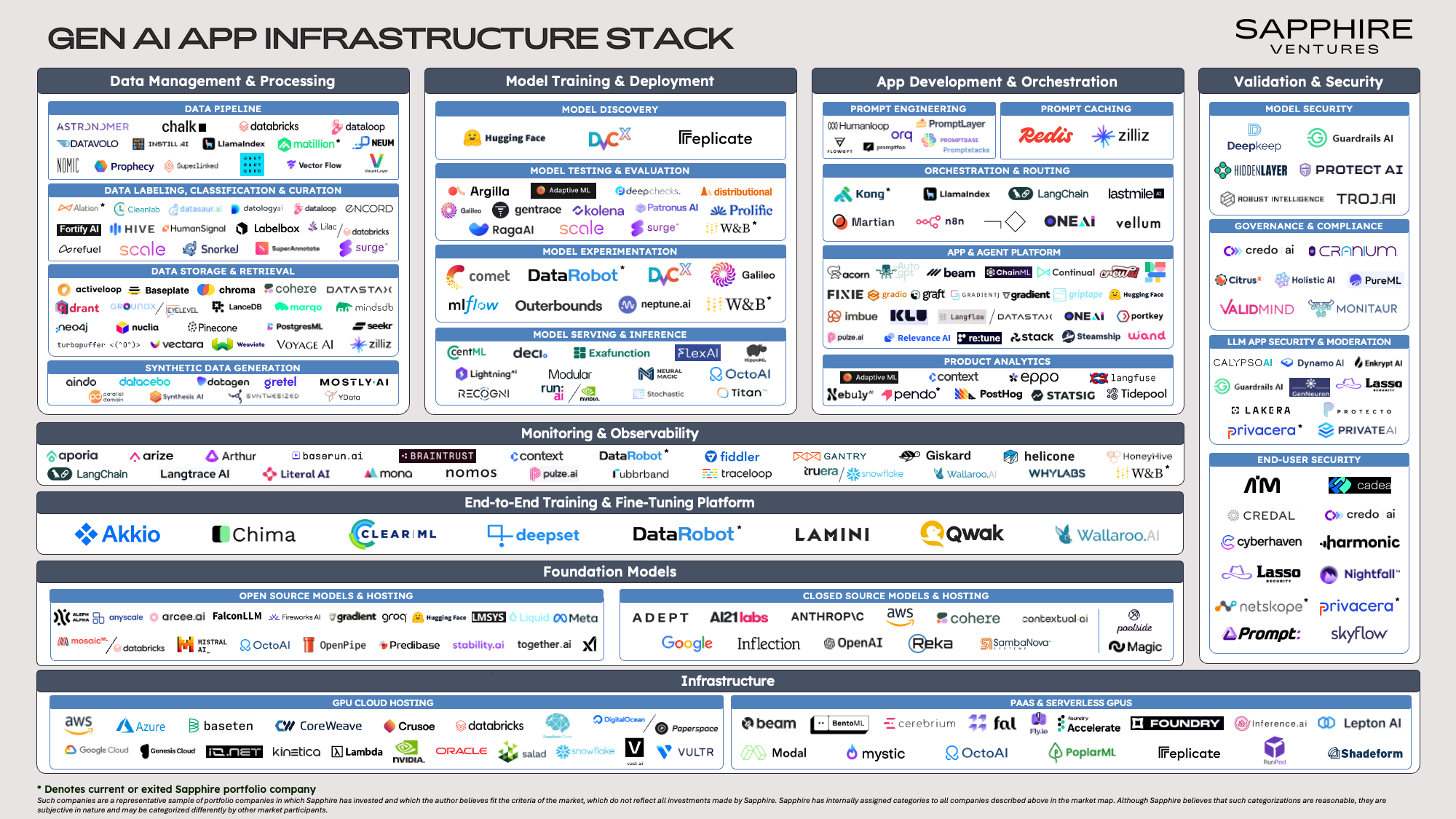
Image by sapphireventures. (2024, May 29 ) Building the Future: A Deep Dive Into the Generative AI App Infrastructure Stack. Retrieved from https://sapphireventures.com/blog/building-the-future-a-deep-dive-into-the-generative-ai-app-infrastructure-stack/
The Open Source Advantage Open source AI solutions offer small businesses unprecedented opportunities to innovate without massive investment. They provide transparency, customization flexibility, and freedom from vendor lock-in. Most importantly, they enable businesses to start small and scale as needed, making AI adoption more accessible than ever.
BentoML and OpenLLM: Production-Grade ML Serving BentoML stands out as a comprehensive solution for serving machine learning models in production, with OpenLLM specifically designed for LLM deployments.
Pros:
- Unified platform for serving multiple ML frameworks
- Built-in model versioning and management
- Flexible deployment options (Docker, Kubernetes, serverless)
- Automatic model quantization (4-bit, 8-bit)
- Built-in prompt templates and caching
- Support for multiple backends (PyTorch, ONNX, TensorRT)
- Streaming responses and load balancing
Cons:
- Steeper learning curve compared to simpler solutions
- Requires understanding of containerization concepts
- More complex setup for distributed deployments
Implementation tip: Start with OpenLLM for quick LLM deployments, then explore BentoML's advanced features like adaptive batching and monitoring. Here's a quick example:
# Deploy LLaMA2 with OpenLLM openllm start llama2 --model-id meta-llama/Llama-2-7b-chat # Custom serving with BentoML @svc.api(input=Text(), output=Text()) def generate(self, prompt: str) -> str: return self.llm.generate(prompt)
vLLM: High-Performance Inference Engine vLLM stands out as a powerful open-source inference engine designed for Large Language Models (LLMs).
Pros:
- Exceptional throughput with PagedAttention technology
- Supports multiple popular model formats (BLOOM, LLaMA, OPT)
- Easy integration with existing Python applications
- Efficient memory management for handling multiple requests
Cons:
- Requires significant GPU resources for optimal performance
- Learning curve for proper configuration and optimization
- May need technical expertise for deployment and maintenance
Implementation tip: Start with a smaller model like BLOOM-1b7 to test your setup before scaling to larger models.
Llama Edge: AI at the Edge Llama Edge brings AI capabilities directly to edge devices, opening new possibilities for local processing and reduced latency.
Pros:
- Minimal latency with local processing
- No continuous internet connection required
- Enhanced privacy as data stays on-device
- Lower operational costs long-term
Cons:
- Limited model size due to device constraints
- May require optimization for specific hardware
- Performance varies based on device capabilities
Implementation tip: Begin with quantized models optimized for edge deployment. Focus on specific use cases that benefit from local processing.
Llama.cpp: Lightweight and Versatile Llama.cpp has emerged as a go-to solution for running LLMs on consumer hardware.
Pros:
- Runs on standard CPU hardware
- Excellent memory efficiency through quantization
- Simple installation and deployment process
- Active community support
Cons:
- Lower inference speed compared to GPU solutions
- Limited to specific model architectures
- May require careful parameter tuning for optimal performance
Implementation tip: Start with 4-bit quantized models for the best balance of performance and resource usage.
Building Your AI Solution When implementing these tools, consider this practical approach:
Assessment Phase:
- Evaluate your hardware capabilities and requirements
- Define specific use cases and performance needs
- Consider your scaling strategy
- Assess team expertise with containerization and ML ops
Development Strategy:
- Start with proof-of-concept implementations
- Test with smaller models before scaling
- Build monitoring and evaluation systems
- Implement caching and optimization strategies
Deployment Considerations:
- Implement proper error handling
- Plan for model updates and maintenance
- Consider hybrid approaches when necessary
- Monitor resource usage and costs
Looking Ahead Stay tuned as I dive deeper into each of these four key areas. I'll share my experiences in leveraging the vast open source ecosystem to create robust, competitive digital experiences while maintaining control over technology stack and costs.
,References:
- BentoML Documentation and Guides (2024) https://docs.bentoml.org/ A comprehensive guide to model serving and deployment with BentoML
- vLLM: Easy, Fast, and Cheap LLM Serving with PagedAttention (2023) https://vllm.ai/ Technical documentation and implementation guides for vLLM
- Llama.cpp: Inference of LLaMA models in pure C/C++ (2023-2024) https://github.com/ggerganov/llama.cpp Original implementation and documentation for running LLMs on CPU
- OpenLLM: Operating LLMs in Production (2024) https://github.com/bentoml/OpenLLM Production-ready LLM serving and fine-tuning framework


